The Non-Obvious Trend Report Archive
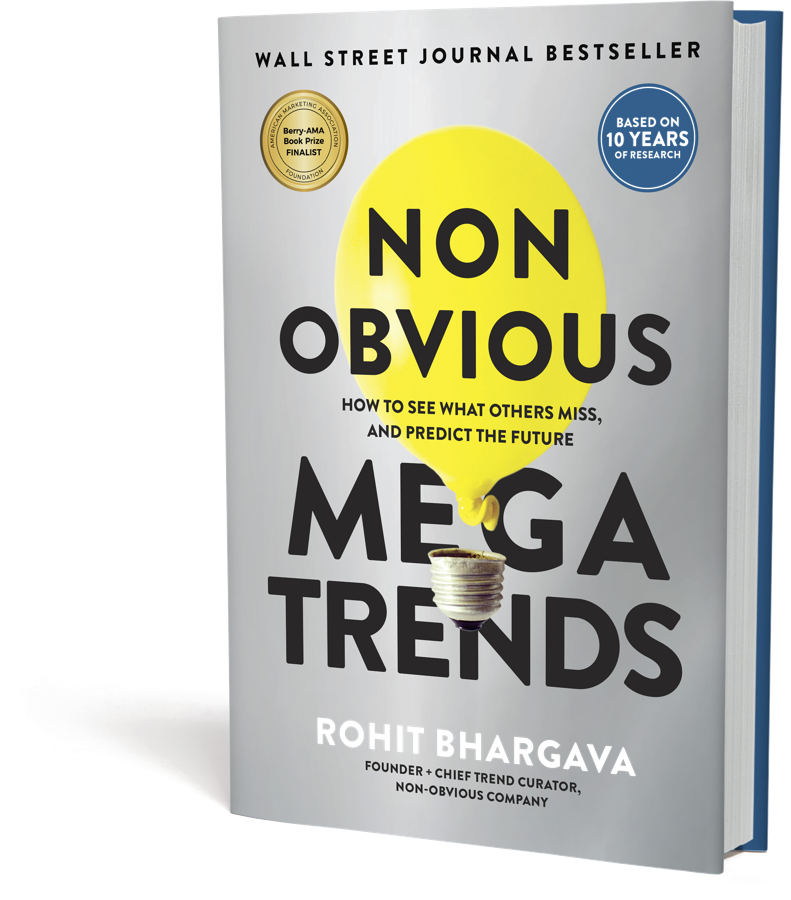
The tenth and final edition ended the series exactly as planned. Instead of 15 new trends, it distilled a decade of research into ten megatrends built to last, plus the complete Haystack Method. It won the Montaigne Medal and the Stevie Award for Best Business Book of the Year.
10 megatrends
Every megatrend was distilled from a decade of earlier trend research. Below, the full evolution of each one: the past trends that led up to it, in the order they were first curated.
Megatrend 01 · The Evolution · 7 past trends
The ability to share a carefully crafted online personality allows people to use social content such as selfies (yes, selfies) to build their own confidence.
The growth of personalization leads more consumers to expect that their everyday interactions will be transformed into celebrity-type experiences.
As behavioral measurement tools map the details of our personalities, brands start using such data to bring like-minded people together to engage in unique experiences.
After years of being minimized, multicultural citizens find widespread acceptance through a growing integration of diverse ideas and people in entertainment, products, and politics.
A new generation of creators become authentic fameseekers, turning to social media to establish their brands, build an audience, and become the next big thing.
The rise of outsiders and their increasing willingness to say or do the things we might describe as outrageous to capture attention and influence.
As the global shift toward individualism continues, people of all ages embrace what makes them unique, follow their passion, can start a side business, and increasingly appreciate the quirky differences in one another.
As individualism rises globally, people are carefully cultivating how they are perceived both online and offline, chasing stardom, and making themselves vulnerable to criticism in the process.
Megatrend 02 · The Evolution · 5 past trends
Business leaders, pop culture, and groundbreaking research intersect to prove that our ideal future will be led by strong and innovative women working on the front lines.
Across media and entertainment, gender roles start to reverse, assumptions about alternative lifestyles are challenged, diversity increases, and perceptions of how people are defined continue to evolve.
The fierce, independent woman has emerged in recent years, redefining the concept of femininity and reimagining gender roles.
Shifting definitions of traditional gender roles are leading some to reject the notion of gender completely, while others aim to mask gender from products, experiences, and even their own identities.
The rising empowerment of women and the reevaluation of gender are causing widespread confusion and angst about what it means to be a man today.
Traditional gender divisions and labels are getting replaced with a more fluid understanding of gender identity, forcing a reevaluation of how we see employees, customers, brands and one another.
Megatrend 03 · The Evolution · 4 past trends
The quality of e-learning content explodes as more students consider alternatives to traditional college educations.
Successful entrepreneurs and companies create on-the-side consulting models to help others duplicate their success.
As online platforms offer access to learn directly from experts, expertise itself becomes more inclusive, less academic, and widely available on demand.
The road to mastery on any topic accelerates with the help of bite-sized learning modules that make education more efficient, engaging, useful, and fun.
As we become accustomed to consuming bitesized knowledge on demand, we benefit from learning everything more quickly but risk forgetting the value of mastery and wisdom.
Megatrend 04 · The Evolution · 7 past trends
As a result of the digital revolution, people place more value on physical objects in print.
Consumers selectively skip upgraded versions and opt for simpler, cheaper, and sometimes more functional versions instead.
Technology is offering new ways to preserve history, changing the way we learn from, experience, and remember the past in the process.
As technology, media clutter, and an overload of gadgets make life increasingly stressful, people are seeking moments of reflection and pause.
Overwhelmed by digital and tired of sitting behind a screen, consumers are seeking products and experiences that they can touch and feel.
As tech-enabled products become overbearing, consumers opt to downgrade to simpler, cheaper, or more functional versions instead.
Often unsure of whom to trust, today’s consumers are connecting with brands that have a rich legacy in cultural history, or those for which they have a strong sense of nostalgia.
Overwhelmed by technology and a sense that life is now too complex and shallow, people seek out simpler experiences that offer a sense of nostalgia and remind them of a more trustworthy time.
Megatrend 05 · The Evolution · 10 past trends
Content shared on social media gets more emotional as people share amazing examples of humanity and brands inject more into their marketing communications efforts.
As people seek more personal and human experiences, brands and creators intentionally focus on using personality, quirkiness, and intentional imperfections to make their products and experiences more authentic and desirable.
A rise in virtual reality experiences will lead to greater human and corporate empathy thanks to the immersive ability to see the world through unfamiliar eyes.
Luxury is no longer defined by scarcity and privilege, but rather through more down-to-earth human experiences that create unforgettable moments worth sharing.
As automation increases, people hungry for more personal and authentic experiences begin to put a premium on advice, services, and interaction involving other people.
Empathy becomes a driver of innovation and revenue and a point of differentiation for products, services, hiring, and experiences.
Tired of technology that isolates us from one another, people seek out and place greater value on physical, authentic and “unperfect” experiences designed with empathy and delivered by humans.
Megatrend 06 · The Evolution · 10 past trends
Aggressive honesty will lead to edgier and more effective marketing as brands reveal this unexpected tactic that consumers welcome.
The best retailers create passionate users who not only buy products but also rave about their experiences. They inspire those on their social networks to try the products themselves.
In the coming year, more retail stores will create unique experiences using the principles of theater to engage customers with memorable experiences.
Organizations discover that taking people behind the scenes of their brand and history is one of the most powerful ways to inspire loyalty and drive purchase.
As the line between news and entertainment blurs, smart curation displaces journalism as engaging content is paired with sensational headlines to drive millions of views.
Brands increasingly invest in high-touch, in-store experiences to build brand affinity and educate customers, while seamlessly integrating online channels to complete actual purchases and fulfill orders.
Media, data analytics, and advertising are combining forces to create a perpetual stream of noise that is intended to incite rage and elicit angry reactions on social media and in real life.
With trust eroding in media and institutions, people are engaging in a personal quest for the truth based on direct observation and face-to-face interaction.
Creators, corporations, and governments use virtual creations to shift public perception, sell products, and even turn fantasy into reality.
Brands and creators intentionally use spectacles to capture attention and drive engagement.
In the information economy, our attention is our most valuable resource, leading us to be more skeptical of those who manipulate us to get it, and instead seek out and trust those who communicate in more authentic ways.
Megatrend 07 · The Evolution · 6 past trends
Design takes a leading role in the introduction of new products, ideas, and campaigns to change the world.
Companies increasingly put brand purpose at the center of their organizations to show a deeper commitment to doing good as a part of business.
Our tendency to celebrate visionary entrepreneurs inspires a new generation of startup founders to think beyond profit and consider how their businesses can make a positive social impact and even save the world.
Reacting to a polarized media atmosphere, more brands feel compelled to take a stand and highlight their core values rather than try to be all things to all people.
Empowered with more information about products and services, people are choosing to make a statement about their values and the world today through what they buy, where they work, and how they invest.
The urgency of the problems facing humanity is inspiring corporations, entrepreneurs, and individuals to find ways of doing good (and generating results) faster.
As consumers and employees demand more sustainable and ethical practices from businesses, companies respond by adapting products, taking stands on issues, and putting purpose first.
Megatrend 08 · The Evolution · 6 past trends
Tracking tools offer individualized data to monitor and measure all areas of your life.
Wearables offer new ways to collect data, yet their usefulness remains limited to superficial analysis that fails to offer actionable insights.
Data breaches lead to a new global paranoia about what governments and brands know about us and how they might use this information in illicit ways.
As consumers increasingly collect their own information, brand-owned “big data” become less valuable than immediately actionable “small data” owned by consumers themselves.
An overload of personal, open, and corporate data leads organizations to go beyond algorithms and look to artificial intelligence, curation, and startups to make the data meaningful.
As we create more methods for quantifying the world around us, data gets manipulated, contaminated and sabotaged, making it harder to separate true insights from useless noise.
The growing ubiquity of data and the myriad ways it can be collected raise big questions about how to make it truly useful, who owns the data, and who should stand to profit from it.
Megatrend 09 · The Evolution · 4 past trends
Brands are increasingly creating smarter products that monitor our safety and health, alerting us when we need to take action.
As it is taking longer to emerge into full adulthood, innovative services are helping us automate common adult tasks.
Technology becomes better at anticipating and predicting what we need while simultaneously blending more seamlessly and unnoticeably into our lives and the world around us.
Advances in robotics, including human-like interfaces, are leading us to raise questions about how we relate to that technology.
As we increasingly rely on predictive technology that keeps us and our world safe and makes life more convenient, we must contend with the privacy trade-offs required to make it work.
Megatrend 10 · The Evolution · 9 past trends
New services and technology make it easier for anyone to invest in local businesses and buy from local merchants.
As the barriers to starting a new business begin to fall, incentives and tools mean anyone with an idea can launch a startup knowing that the costs and risks of failure are not as high as before.
New business models and tools allow consumers and brands to tap the power of sharing and collaborating to find new ways to buy, sell, and consume products and services.
More businesses and retailers use subscriptions to sell recurring services or products to customers instead of focusing on one-time sales.
Creators and makers use new models for distribution to disrupt the usual channels, cut out middlemen, and build more direct connections with fans and buyers.
Brands increasingly invest in high touch in-store experiences to build brand affinity and educate customers, while seamlessly integrating online channels to complete actual purchases and fulfill orders.
Companies desperate to be more innovative increasingly look to bring more outside innovators in-house, enticing them with funding, beautiful co-working lab spaces, and a feel good pitch.
Consumers get weary of innovations claiming to be the next big thing and assume none will last long.
Fear leads entrepreneurs, businesses, and institutions to envy competitors and approach innovation with admiration or desperation.
As the lines between industries erode, how we sell and buy anything changes constantly, leading to a continual disruption of business models, distribution channels, consumer expectations and even innovation itself.

Want To Use These Trends?
Bring this trend and more to your group with a customized keynote presentation or workshop session with Rohit Bhargava. Non-Obvious Thinkers win the future. Let’s explore how we can help you do this for yourself.
Learn More & Check Availability
Want More Non-Obvious Ideas?
The Non-Obvious Insights Newsletter brings you the five or six most fascinating and overlooked stories of the week, with a quick take on why each one matters.
One email every Thursday. No spam, unsubscribe anytime.
The Non-Obvious Insights Newsletter
The most interesting stories of the week, and why they matter. Join more than 25,000 readers.
One email every Thursday. No spam, unsubscribe anytime.