The Non-Obvious Trend Report Archive
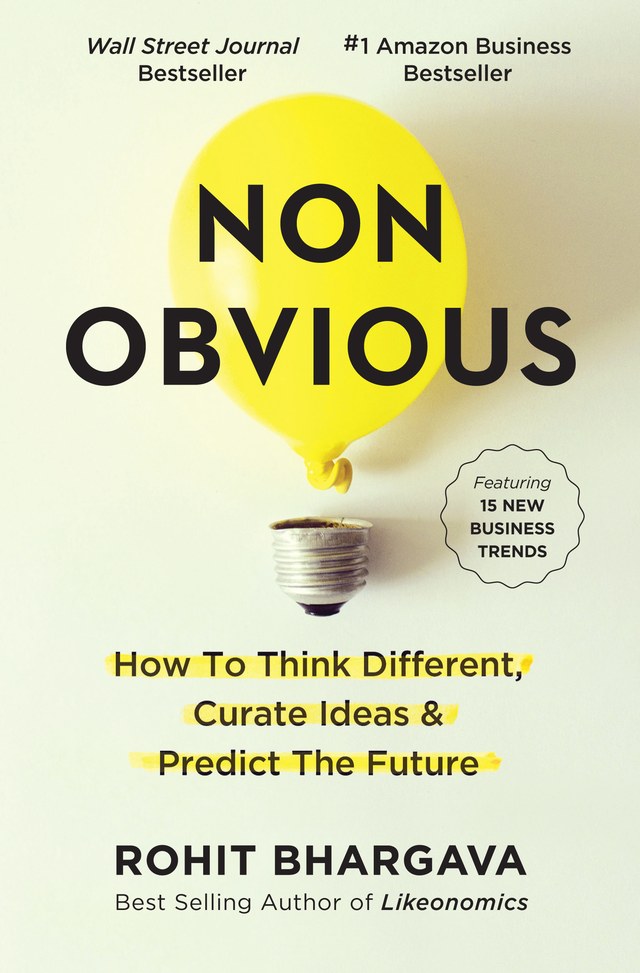
For the first time, the report was released exclusively as a full-length book, adding an extensive section on the process of trend curation itself. It became an instant Wall Street Journal bestseller and put the Haystack Method into readers’ hands.
The Story Of The 2015 Report
This year Non-Obvious was first published in hardcover format, and the trend report truly took off. The book was an instant Wall Street Journal best seller. For the first time it revealed my full process of trend curation, which I had shared previously only in private corporate workshops. In addition to the explanations about becoming a trend curator and using my Haystack Method, the report introduced several popular trends that drew worldwide media attention. A few highlights from this report included Unperfection, about the preference people often have for naturally flawed and more human products and leaders; Small Data, on the personal information consumers collect on their own behavior; Everyday Stardom, about sometimes unrealistic consumer expectations that they are always VIPs; and Selfie Confidence, on the counterintuitive idea that taking and sharing selfies may be a form of building self-esteem. Beyond the trends, the book's popularity this year introduced trend curation to a much broader audience, and the concept began to resonate globally. The book was contracted for six translated editions, and my speaking and workshop invitations, including more global appearances. The book's success also allowed the Non-Obvious Company to bring on more partners and team members, which in turn allowed us to expand the research and curation abilities and make the future reports even stronger. Everyday Stardom Selfie Confidence Mainstream Mindfulness Branded Benevolence Reverse Retail Reluctant Marketer Glanceable Content Mood Matching Experimedia Unperfection Predictive Protection Engineered Addiction Small Data Disruptive Distribution Micro Consumption
Trend Longevity Ratings measure how well each prediction held up. Graded in 2026.
15 trends
Trend 01 · 2015
Companies increasingly put purpose at the center of their businesses to show a deeper commitment to doing good that goes beyond donating money or getting positive PR.
This was the first of our trends to spotlight brands demonstrating a commitment to the environment, social issues, and ethical business practices, a theme that is discussed in the Purposeful Profit megatrend.
Trend 02 · 2015
Creators and makers use new models for distribution to disrupt the usual channels, cut out middlemen, and build more direct connections with fans and buyers.
This trend has exploded in recent years and is likely to affect even more industries. It is a central concept that we brought back in 2018 and was a driver of the megatrend Flux Commerce.
Trend 03 · 2015
Greater understanding of the behavioral science behind habit formation leads to more designers and engineers intentionally creating addictive experiences that capture consumers' time, money, and loyalty.
If you consider the growth of everything from packaged foods to fantasy sports, this trend is central to how experiences can be engineered to be irresistible whether they are good for us or not.
Trend 04 · 2015
The growth of personalization leads more consumers to expect everyday interactions to be transformed into celebrity experiences with them as the stars of the show.
As companies use big data to personalize experiences and revamp customers' experience, consumers' expectations rise, sometimes verging on the impossible.
Trend 05 · 2015
Content creators use social experiments and real-life interactions to study human behavior in unique new ways and ultimately to build more realistic and entertaining narratives.
It once seemed that media featuring social experiments would continue indefinitely, but this trend has slowed as the popularity of viral experiments to shock and awe wanes.
Trend 06 · 2015
Our shrinking attention spans and the explosion of all forms of content online and offline lead creators to optimize stories for rapid consumption at a glance.
Daily or hourly content keeps attracting attention and is appealing because it is quickly scanned. However, it is a double-edged sword as it pushes makers toward creating a spectacle.
Trend 07 · 2015
Meditation, yoga, and quiet contemplation become powerful tools for individuals and organizations to improve performance, health, and motivation.
Not only did we bring this trend back as a featured trend in 2017, but it has come to describe entire industries, new ways of thinking, and a strong movement to improve ourselves at home and at work.
Trend 08 · 2015
As new payment models, products, and experiences become available in bite-sized portions, multiple industries will experiment with new micro-sized forms of pricing and payments.
This trend continues to show huge potential. Unfortunately, platforms still quibble over micro-currency formats. It remains difficult to use, and microtransactions aren't mainstream.
Trend 09 · 2015
As tracking technology becomes more sophisticated, media, advertising, and immersive experiences like gaming and learning can be tailored to match consumer moods.
As new technology such as the use of facial tracking AI becomes more widespread, the idea that you can be engaged or marketed to based on your mood is likely to gain more traction.
Trend 10 · 2015
A growing concern for privacy coupled with elevated expectations of technology's role in our lives leads to more intuitive products, services, and features to help us live better, safer, and more efficient lives.
This trend is a precursor to our megatrend of Protective Tech and offered an early look at the importance of this type of intuition, an idea we also explore in our 2017 trend of Robot Renaissance.
Trend 11 · 2015
As marketing shifts away from pure promotion, leaders and organizations abandon traditional silos, embrace content marketing, and invest in the customer experience.
Marketing continues to evolve away from promotion and to incorporate lessons from sales, innovation, research, data, and more, which leads to marketers' reluctance about what to call themselves.
Trend 12 · 2015
Brands increasingly invest in high-touch in-store experiences to build brand affinity and educate customers, while seamlessly integrating online channels to complete actual purchases and fulfill orders.
Since this trend first was published, retailers have continued to focus on being experiential and immersive, a fact we further explored in our 2019 trend of Strategic Spectacle.
Trend 13 · 2015
The ability to share a carefully crafted online persona allows people to use selfies to build their own self-esteem and confidence by portraying themselves as they wish to be seen in the world.
The essence of this trend remains unchanged, but how we portray ourselves online or build our confidence has moved far beyond , as you can read in the megatrend of Amplified Identity.
Trend 14 · 2015
As consumers increasingly collect their own data from online activities, brand-owned big data becomes less valuable than small data in certain situations.
The potential of small data to help customize experiences is vast, yet it remains underutilized and difficult to leverage in a meaningful way even though we still collect a lot of it.
Trend 15 · 2015
As people seek more personal and human experiences, brands and creators intentionally focus on personality, quirkiness, and intentional imperfections to be more human and desirable.
The idea that brands and leaders are showing vulnerability and building trust through a willingness to share flaws continues to resonate and is a key ingredient in acting more human.

Want To Use These Trends?
Bring this trend and more to your group with a customized keynote presentation or workshop session with Rohit Bhargava. Non-Obvious Thinkers win the future. Let’s explore how we can help you do this for yourself.
Learn More & Check Availability
Want More Non-Obvious Ideas?
The Non-Obvious Insights Newsletter brings you the five or six most fascinating and overlooked stories of the week, with a quick take on why each one matters.
One email every Thursday. No spam, unsubscribe anytime.
The Non-Obvious Insights Newsletter
The most interesting stories of the week, and why they matter. Join more than 25,000 readers.
One email every Thursday. No spam, unsubscribe anytime.