The Non-Obvious Trend Report Archive
The 2014 edition organized its research into the five categories used ever since: culture and consumer behavior, marketing and social media, economics and entrepreneurship, technology and design, and media and education. Desperate Detox and Curated Sensationalism drew the most attention.
The Story Of The 2014 Report
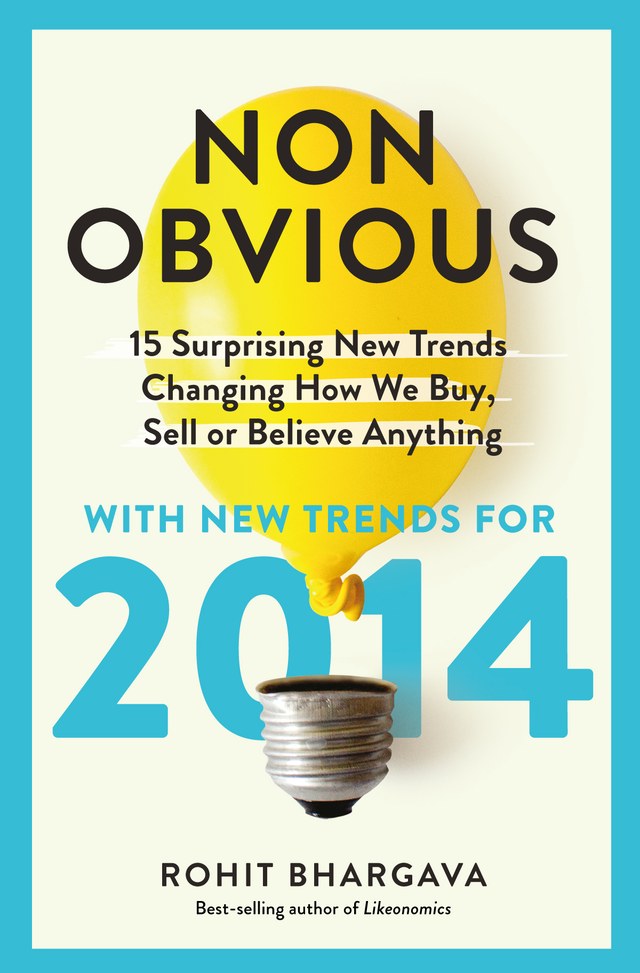
The fourth edition of the trend report was heavily influenced by a dramatic growth in my speaking appearances at conferences across the world. The demand and popularity of the report also led me to leave my role at Ogilvy after eight years to become an entrepreneur, start my own consulting business, and launch a publishing business. For the first time, the trends were broken down into five categories: Culture + Consumer Behavior, Marketing + Social Media, Economics + Entrepreneurship, Technology + Design, and Media + Education. Some of the most popular trends from this year were Desperate Detox, about consumers hungry to escape the ever-present technology around them; Curated Sensationalism, on the increasing use of attention-grabbing headlines; Subscription Commerce, about long-established brands and products shifting to a subscription model; Branded Utility, on brands making their marketing more useful; and Obsessive Productivity, about people's desire to optimize their time in any way possible. These categories were used for the next five years. This report also incorporated some of the trend research on health care that co-author Fard Johnmar and I published in our book ePatient 2015. Desperate Detox Media Bingeing Obsessive Productivity Lovable Imperfection Branded Utility Shareable Humanity Curated Sensationalism Distributed Expertise Anti-stereotyping Privacy Paranoia Overquantified Life Microdesign Subscription Commerce Instant Entrepreneurs Collaborative Economy
Trend Longevity Ratings measure how well each prediction held up. Graded in 2026.
15 trends
Trend 01 · 2014
Across media and entertainment, gender roles start to reverse, assumptions about alternative lifestyles are challenged, diversity increases, and perceptions of how people are defined continue to evolve.
We see new stories that help us re-evaluate people, see gender as fluid, and challenge our long-held assumptions about identity and blurring of what were once distinct lines.
Trend 02 · 2014
Brands use content marketing and greater integration between marketing and operations centers to augment promotions with real ways to add value to customer's lives.
As content marketing continues to grow, brands increasingly find new ways to provide value, answer questions, and use marketing as a tool for education rather than purely for promotion.
Trend 03 · 2014
New business models and tools allow consumers and brands to tap the power of sharing and collaborating to find new ways to buy, sell, and consume products and services.
We are firmly in the middle of the "sharing economy" as the idea of ownership shifts, people use and share products without owning them, and the economy stays collaborative.
Trend 04 · 2014
As the line between news and entertainment blurs, smart curation displaces journalism as engaging content is paired with sensational headlines to drive millions of views.
Media continue to rely on sensationalism, which makes this trend a precursor to many other popular trends in later years, including Truthing, Manipulated Outrage, and Strategic Spectacle.
Trend 05 · 2014
Consumers try to connect more authentically with others and seek out moments of reflection by intentionally disconnecting from the technology surrounding them.
As technology remains omnipresent in our lives, we continue to see new examples of this trend in action almost every week. That led us to bring it back for our 2017 report.
Trend 06 · 2014
The idea of expertise itself shifts to become more inclusive, less academic, and more widely available on demand and in real time.
Learning through experts online in many formats is gaining popularity, and learning platforms are growing quickly. Our ability to access expertise in real time will keep rising.
Trend 07 · 2014
As the barriers to starting a new business begin to fall, incentives and tools mean anyone with an idea can launch a startup knowing that the costs and risks of failure are not as high as before.
While entrepreneurship appeals to more professionals, governments around the world continue to see it as a growth engine and work to make starting a business easier for anyone.
Trend 08 · 2014
Consumers value true authenticity and appreciate the minor imperfections found in products, personalities and brands.
Trend 09 · 2014
As more media and entertainment are available from any device on demand, consumers binge and are willing to pay extra for the convenience.
As streaming options grow exponentially, we will see some fatigue with the idea of binge-watching as consumers feel overloaded and no longer obliged to stay up to date on every show.
Trend 10 · 2014
As communication becomes more visual, design gains more respect, and demand for design skills grows, leading to easier access to bite-sized chunks of design expertise.
While the need for design expertise continues to grow, the narrow vision of this trend solely focused on design resources has limited application or relevance in wider situations.
Trend 11 · 2014
With thousands of life-optimizing apps and instant advice from social media-savvy self-help gurus, becoming more productive has become the ultimate obsession.
People continue to fret over productivity as new books promise tips for life optimization. Many hack their daily chores and seek to save time through any means possible.
Trend 12 · 2014
The value of personal data from wearable devices, for example, is obscured by cute infographics and superficial results that prevent thoughtful analysis of the data and effects on life decisions.
While finding value from the data we collect on ourselves continues to be a challenge, the analytical tools and personal desire to make such data actionable are helping manage the downside.
Trend 13 · 2014
New data breaches are leading to a new global sense of paranoia about what governments and brands know about us and how they might use big data in potentially harmful ways.
While privacy persists as a concern, we are seeing this paranoia shift to empowerment as better oversight makes organizations misusing data far harder.
Trend 14 · 2014
Content shared on social media gets more emotional as people share amazing examples of humanity and as brands inject more feelings into marketing communications efforts.
While human stories matter, this trend was negatively affected by fatigue from overly dramatic media stories and click-baiting headlines, which have made people far more skeptical of such stories.
Trend 15 · 2014
More businesses and retailers use subscriptions to sell recurring services or products to customers instead of focusing on one-time sales.
More industries and brands are turning to the lessons of subscription commerce, but it has led to burnout as consumers sometimes long for buying products or services the old way.

Want To Use These Trends?
Bring this trend and more to your group with a customized keynote presentation or workshop session with Rohit Bhargava. Non-Obvious Thinkers win the future. Let’s explore how we can help you do this for yourself.
Learn More & Check Availability
Want More Non-Obvious Ideas?
The Non-Obvious Insights Newsletter brings you the five or six most fascinating and overlooked stories of the week, with a quick take on why each one matters.
One email every Thursday. No spam, unsubscribe anytime.
The Non-Obvious Insights Newsletter
The most interesting stories of the week, and why they matter. Join more than 25,000 readers.
One email every Thursday. No spam, unsubscribe anytime.