The Non-Obvious Trend Report Archive
The second edition took a broader look at business beyond marketing, bringing together corporate marketing, charitable causes and even the marketing of death. It was among the first to explore big data’s potential, from supply chain logistics to quantifying every aspect of our lives, alongside the rising sense of social loneliness and the digital afterlife of loved ones.
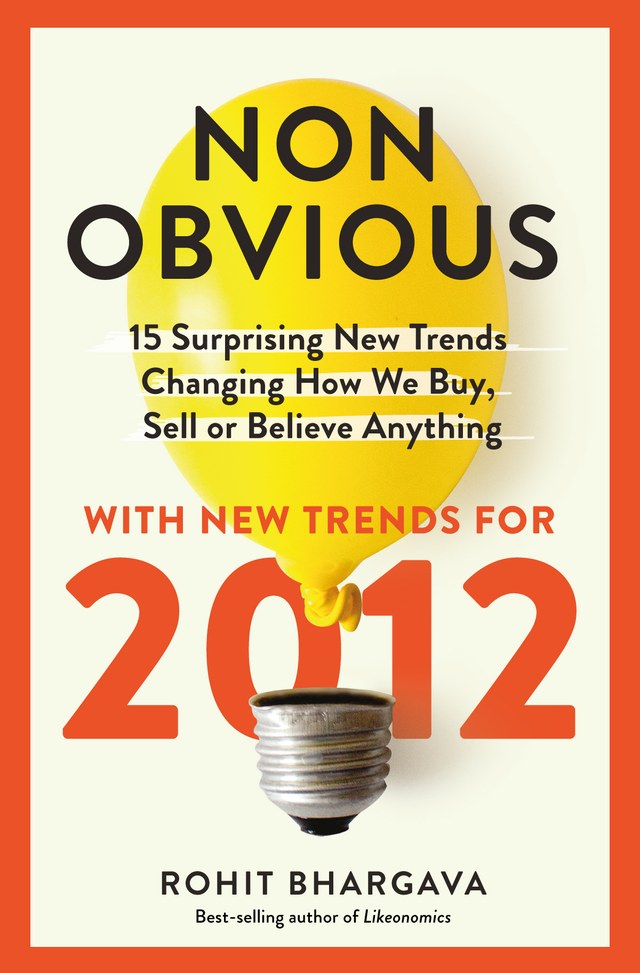
The Story Of The 2012 Report
Capitalizing on the success of the first year's report, the second edition continued the focus on marketing and social media trends and surpassed the original's popularity. Topics covered in this edition included the sensitive yet emerging field of the Digital Afterlife, the rise of Social Loneliness, and the growth of Corporate Humanism. In contrast to the inaugural report, this update took a more human tone as many of the trends described cultural shifts and consumer behavior. The second year had a few big hits as well as a few big misses. The overall trends that centered on the growth of humanity in companies and consumers stood the test of time. On the flip side, several trends from this year turned out to be overly quirky niche concepts. Pointillist Filmmaking and Social Artivism did not quantifiably take off as expected. The mix of trends helped me hone the process and make a big leap the following year in both the quality of the predictions and the detail behind them. Corporate Humanism Ethnomimicry Social Loneliness Pointillist Filmmaking Measuring Life Co-Curation Charitable Engagement Medici Marketing Digital Afterlife Real-Time Logistics Social Artivism Civic Engagement 2.0 Tagging Reality Changesourcing Retail Theater
Trend Longevity Ratings measure how well each prediction held up. Graded in 2026.
15 trends
Trend 01 · 2012
Crowdsourcing itself is evolving beyond sharing information to a point where people can use the collaborative power of the crowd to achieve personal, social, or political change.
The basic idea behind this trend focuses on crowdsourcing moving beyond information and into action as people tap the power of crowds to achieve real things, which continues today.
Trend 02 · 2012
More charities rethink their focus on quick donations and instead promote participation through gaming and other methods of behavioral engagement.
While charities and nonprofits find more ways to engage donors , the predicted focus on participation hasn't really overtaken the breakdown between short-term fundraising and longer-term engagement.
Trend 03 · 2012
A growing range of digital tools allows people to engage more actively with local governments on everything from reporting potholes to offering suggestions for improving their communities.
Though civic engagement hasn't multiplied yearly, more people are adopting these tools to allow deeper citizen engagement, and tech-savvy cities are helping this trend accelerate into the mainstream.
Trend 04 · 2012
Curation gets more collaborative as amateurs and experts combine forces online to add their unique points of view and bring together multiple angles of many issues.
Even as new tools have made it easier for anyone to curate information, the idea that this would lead to more collaboration around that curation was perhaps overly optimistic and hasn't come to fruition.
Trend 05 · 2012
Companies find their humanity as they create more consumer-friendly policies and practices, spend more time listening to customers, and encourage employees to represent them in public.
This may be the most enduring of all the trends we have predicted over the past nine years as we constantly see new examples of companies finding their humanity and avoiding facelessness.
Trend 06 · 2012
During the past year, more companies started to focus on the digital afterlife, creating tools, education, and services to help manage all the data that loved ones leave behind when they die.
This trend perhaps more than any other exemplifies the frustrating reality of a trend that always seems to be emerging as a mainstream idea but never quite makes it into the wider conversation.
Trend 07 · 2012
Ethnographic analysis of how people interact in the real world inspires new social tools or products that mimic human behavior and social interaction as well as fit our lives.
While some of the examples in this trend were dated (Google+), the concept of companies watching human interaction and tailoring products and services accordingly continues to have relevance.
Trend 08 · 2012
A growing range of tracking tools handle individualized data to monitor and measure all areas of your life. They allow you to track your own health, measure your social influence, and set goals.
What was a big idea in 2012 has now become mainstream as we seem surrounded by tracking devices-so this trend undeniably accelerated.
Trend 09 · 2012
Inspired by the book The Medici Effect, this trend describes how thinking from multiple disciplines is combined to make marketing more engaging, creative, or useful.
Though the book is still excellent, the name was too limiting to describe the scope of this trend-but the idea that marketing is (and should be) a melting pot for multidisciplinary thinking continues.
Trend 10 · 2012
Named after the painting form using dots to create larger images, this trend describes a form of collaborative filmmaking in which numerous short clips are merged to tell a broader story through video.
This trend is perhaps my favorite disappointment. I loved the idea, but it was just too narrow to truly grow into a full trend and should have been an ingredient that elevated to a bigger idea.
Trend 11 · 2012
Tech-savvy businesses use real-time conversation in social media to generate insights that help with supply chain and logistical planning to eliminate waste and maximize profits.
Supply chain software continues to grow more sophisticated as large retailers and other distributors implement new tools to get better forecasts and leverage social conversation data to run better.
Trend 12 · 2012
In the coming year, more retail stores will create unique experiences using the principles of theater to engage customers with memorable experiences.
Retailers have tried to get even more theatrical to combat the dangers of showrooms and the rise of online retail. If anything, this is making retail experiences even more interactive and dramatic than before.
Trend 13 · 2012
The intersection between art and activism, known increasingly as artivism, get social as artists see social tools to reach more people and create greater societal impact.
Art is used frequently for activism, and social media amplify it, but this trend should have been part of an elevated idea that went beyond just art for social issues.
Trend 14 · 2012
Despite online connections, people feel a real-world sense of loneliness, prompting them to seek ways to create deeper friendships or at least a chance to connect with people in deeper ways.
Loneliness persists, and our digital connectivity continues to be a double-edged sword, making us feel more connected and isolated simultaneously, particularly among youth and the elderly.
Trend 15 · 2012
Better-quality mobile cameras allow developers to create tools that can tag any object in reality to unlock interactive content.
The prevalent use of QR codes and tags that mapped reality to the online world seemed in 2012 as if it would be huge, but the trend never materialized as originally predicted.

Want To Use These Trends?
Bring this trend and more to your group with a customized keynote presentation or workshop session with Rohit Bhargava. Non-Obvious Thinkers win the future. Let’s explore how we can help you do this for yourself.
Learn More & Check Availability
Want More Non-Obvious Ideas?
The Non-Obvious Insights Newsletter brings you the five or six most fascinating and overlooked stories of the week, with a quick take on why each one matters.
One email every Thursday. No spam, unsubscribe anytime.
The Non-Obvious Insights Newsletter
The most interesting stories of the week, and why they matter. Join more than 25,000 readers.
One email every Thursday. No spam, unsubscribe anytime.