What’s In This Issue?
 Story 01The Dating App That Gives You One Date and No Swiping Left
 Story 02The Unintended Consequences of Dumb Solutions
 Story 03Why Roku's 24/7 AI TV Channel Could Be Better Than You Think
 Story 04Effortlux
Even More Stories
- Could humans learn a language made entirely of music?
- You’re Thinking About Online Trends All Wrong
- Just In Time For College Move Ins, This IKEA Complexity Index Shows The Hardest IKEA Products To Build
- What happens when medical students rely on AI – and never develop their own judgment?
- Time Magazine Now Running Ads Meant Specifically to Influence AI Agents
- “This price was set by an algorithm”: News subscribers are surprised by a new line in their renewal emails
Media Recommendation
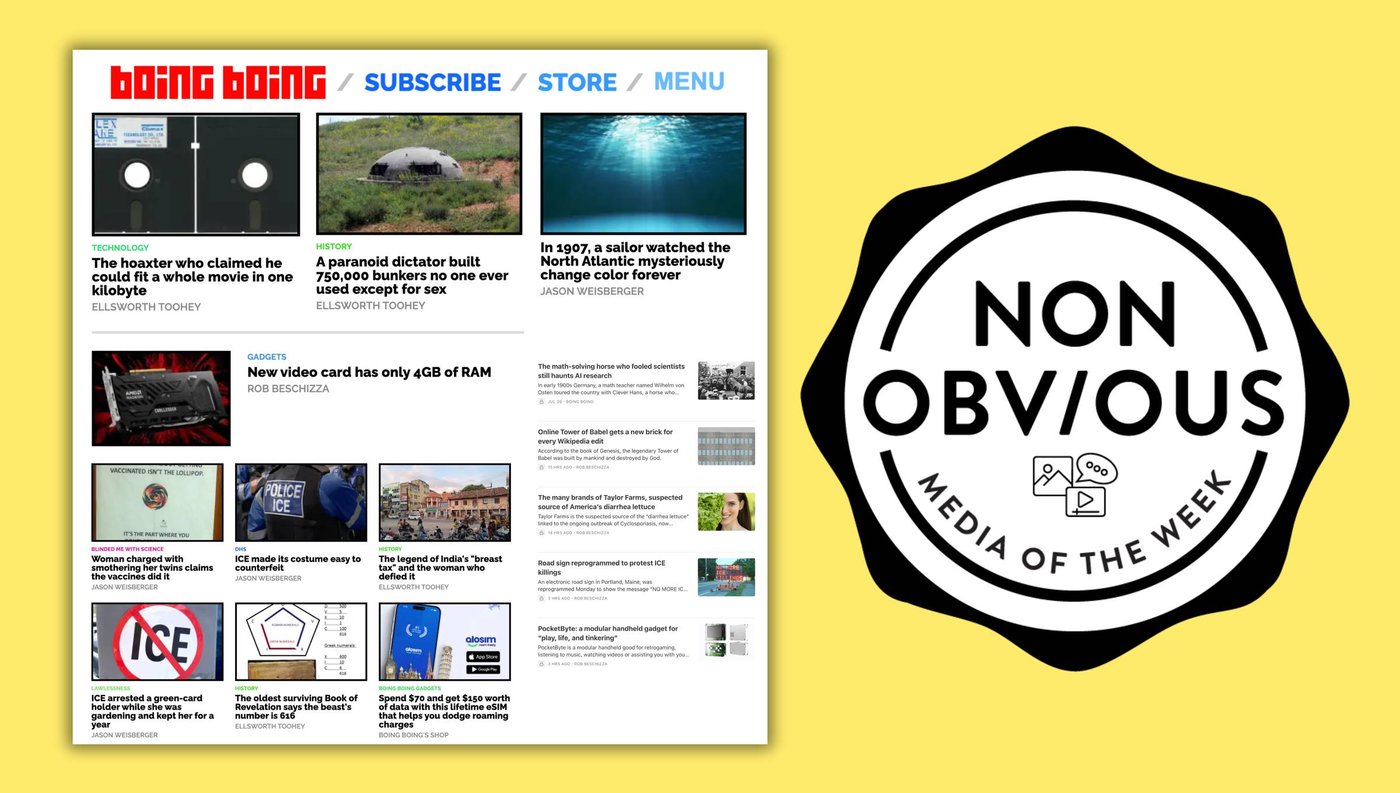 Boing Boing
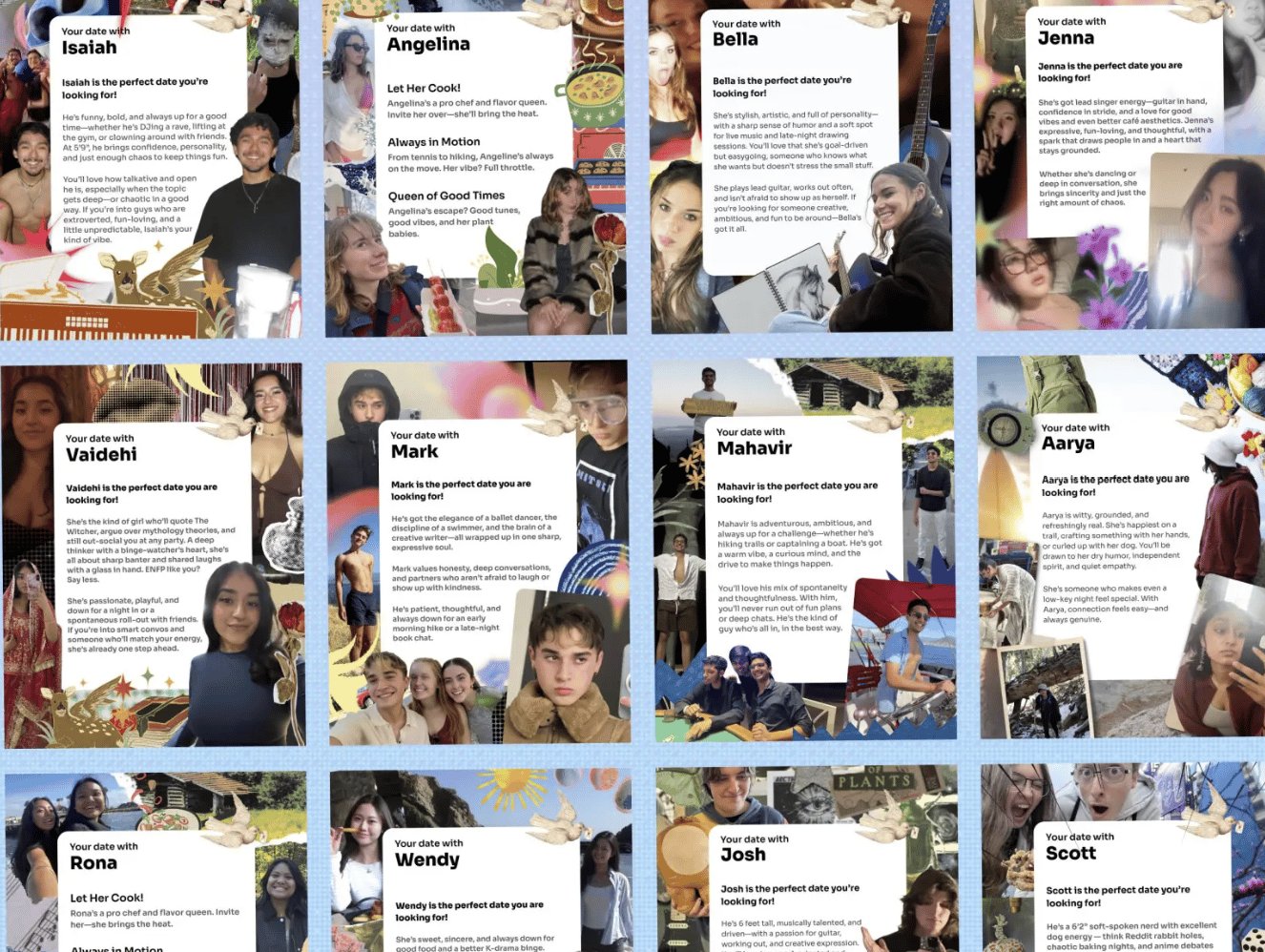
The Dating App That Gives You One Date and No Swiping Left
Online dating, in one way or another, has always been about swiping right or left. You go through lots of profiles, choose some that seem appealing and then try to make a connection from there. Like a lot of other networking, it feels like a numbers game. You have to go on a certain number of dates or swipe right on the right number of profiles before you find the one ... or at least one that you like enough to spend time with. Ditto has a different approach, using algorithmic scarcity as a differentiator.
“It comes with the person, it comes with a time, it comes with a location, and the users simply just need to show up and date each other and come back. We’ll collect more feedback about the date, and then improve our understanding of the user, and send them to a better next date,” Wang said. “Right now, people’s goal is really just to go out there and meet each other, so it’s actually removing a lot of friction for our users, so that we are doing the heavy lifting for them, and they just simply go there and then meet whoever.”
Like most platforms, the founder believes in the power of the algorithm to predict chemistry between two people. What's more interesting about the platform, though, is how much friction it removes from the process of meeting up altogether. They pick the person, the time, the day, and the location. You just show up. The ease of use combined with some pretty creative marketing (like their search for a Chief Yacht Officer to throw parties for them), is already getting some attention. If it works, we may see more apps and tools that also tailor their offerings to this sort of narrow casting where you're not left with search results or a list of recommendations but rather a single option as your choice - take it or leave it.
The Unintended Consequences of Dumb Solutions
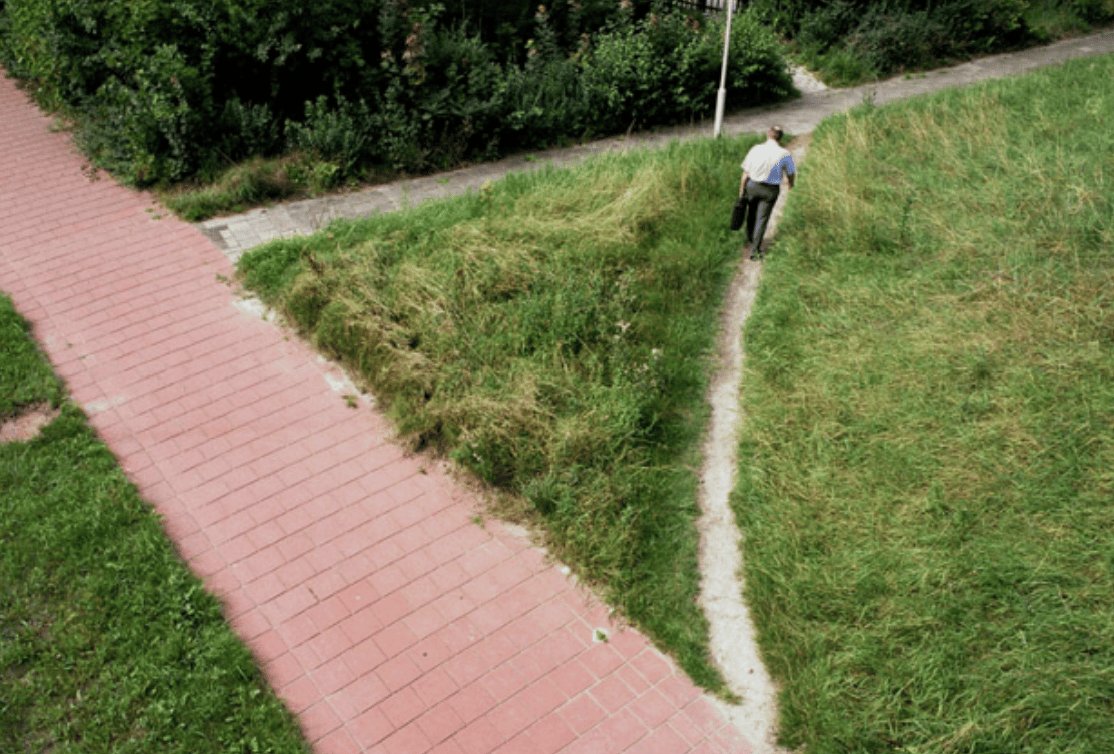
In urban planning, the idea of the "desired path" is the one that people will take and often create for themselves, which differs from the one that was planned for them. It's a useful analogy to describe lots of other moments from human history too, if you consider how often humans have implemented solutions to problems that quickly backfired. Introducing one invasive species to control the problem of another rarely turns out well, for example. No matter how often we see it, someone always seems to be coming up with another dumb solution just around the next corner.
This week's immediately backfiring idea comes from Anthropic's announcement, in response to new EU regulation requiring content be flagged as having been created with AI, that they have added watermarking for images and for text to indicate that it was created by AI. This means that not only will images be tagged as having been generated (which is mostly a good thing), but any text created or edited by Claude in any way will also carry the same watermark, regardless of who first created it. So if you write a piece of work and run it through AI tools at the end of a proofread or grammar check or some other type of editing, the watermark will show up and tag the text as AI generated.
"Once again, regulators have forced a solution that creates far more problems than it can ever solve. It will flag the innocent and miss the determined. Worse, it hands institutions a probabilistic signal they will treat as proof. From now on, the text and images you generate or simply pass through Claude will carry an invisible watermark. Anthropic says detection tools are “forthcoming.” That’ll be when the fun really starts. We might as well just call this “False Positives for Everyone.”
Now the next race is on to find tools that allow users to bypass these protections, and perhaps there will be a surge in hiring typists off Fiverr to take AI-edited work and retype it without the watermarks. Regardless, the point is we're now in the technology era of dumb solutions - and those won't be so easy to just walk around.
Why Roku's 24/7 AI TV Channel Could Be Better Than You Think
Last week one of the free channels rolled out on Roku (which comes pre-loaded on all new Smart TVs) promised to offer a 24/7 feed of AI generated content. The launch generated plenty of the sort of criticism you would expect from journalists and reviewers alike:
"It sounds more like a concept for a sci-fi torture device than it does a source of genuine entertainment, but it is, unfortunately, real. In one clip that gives an idea of the bottom-of-the-barrel slop that it’s force-feeding viewers." If there is a plot, it’s masterfully hidden underneath the bizarre way it cuts to different scenes, not to mention dialog that’s delivered with the cadence and awkward pauses of a mid-2000s video game cutscene. No one blinks when they talk." “Finally, AI can unleash the creative potential of people who can’t write, don’t understand pacing or transitions, are unfamiliar with human facial expressions, etc,” one observer joked.
Here's what no one was saying: even with its flaws, there are early signs that this could be a brilliant idea. The pitch for creators from channel creator Fairground AI promises AI filmmakers "the biggest stage you've never had" by uploading their content and there is apparently some sort of curation to decide what gets aired. Unfortunately, most of the content is made up of AI-generated micro-dramas like Liminal Land that veer into the uncanny valley of AI slop with no real plot and noticeably robotic "acting."
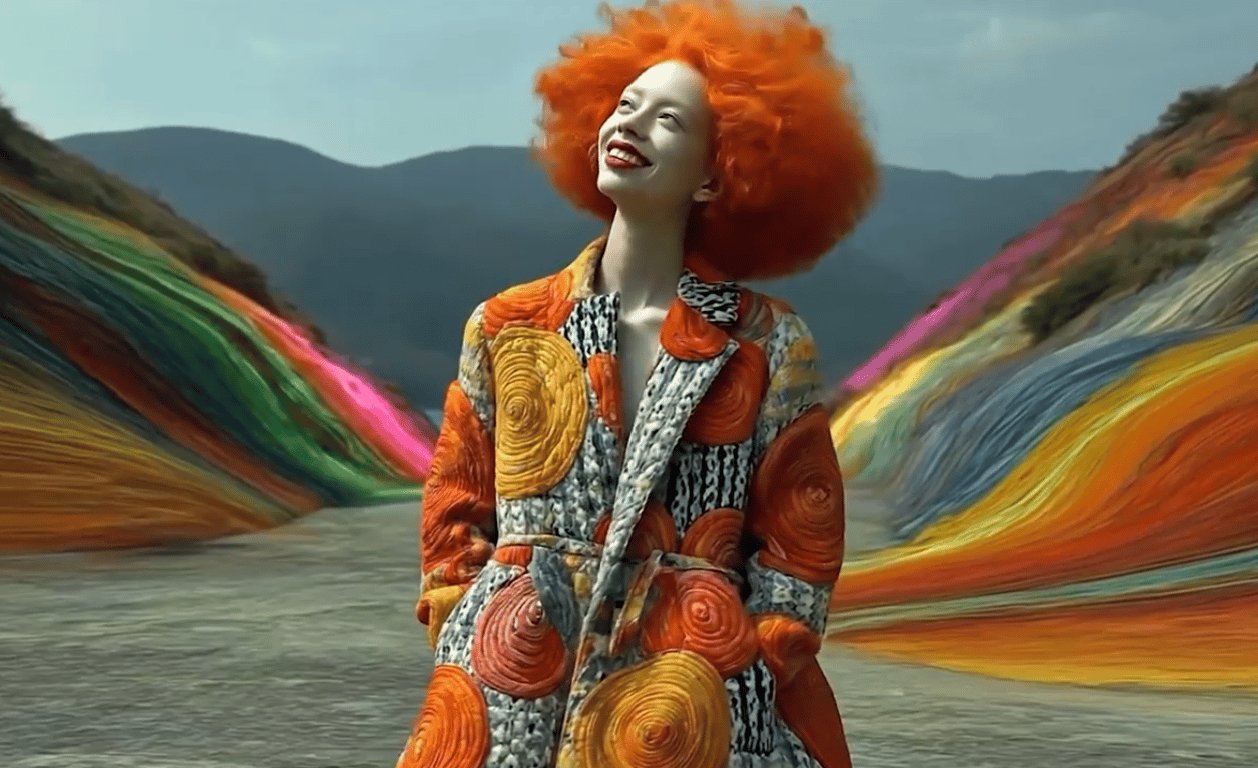
In contrast, the best content on the platform is from masterful creators who use AI to make entirely new forms of art, like the work of Kelly Boesch. Her surreal visionary videos and original songs are addicting and unlike anything else you'll find on TV. This channel could have had more of that. Their mission could have been dedicated to finding and showcasing new forms of art and storytelling. If they had done that, this channel could have offered something you really can't get anywhere else. In other words, a 24/7 stream of AI generated content doesn't have to suck ... but it will if you choose to mostly fill it with things created by untalented people trying to use AI to do things people are still better at doing themselves.
Effortlux
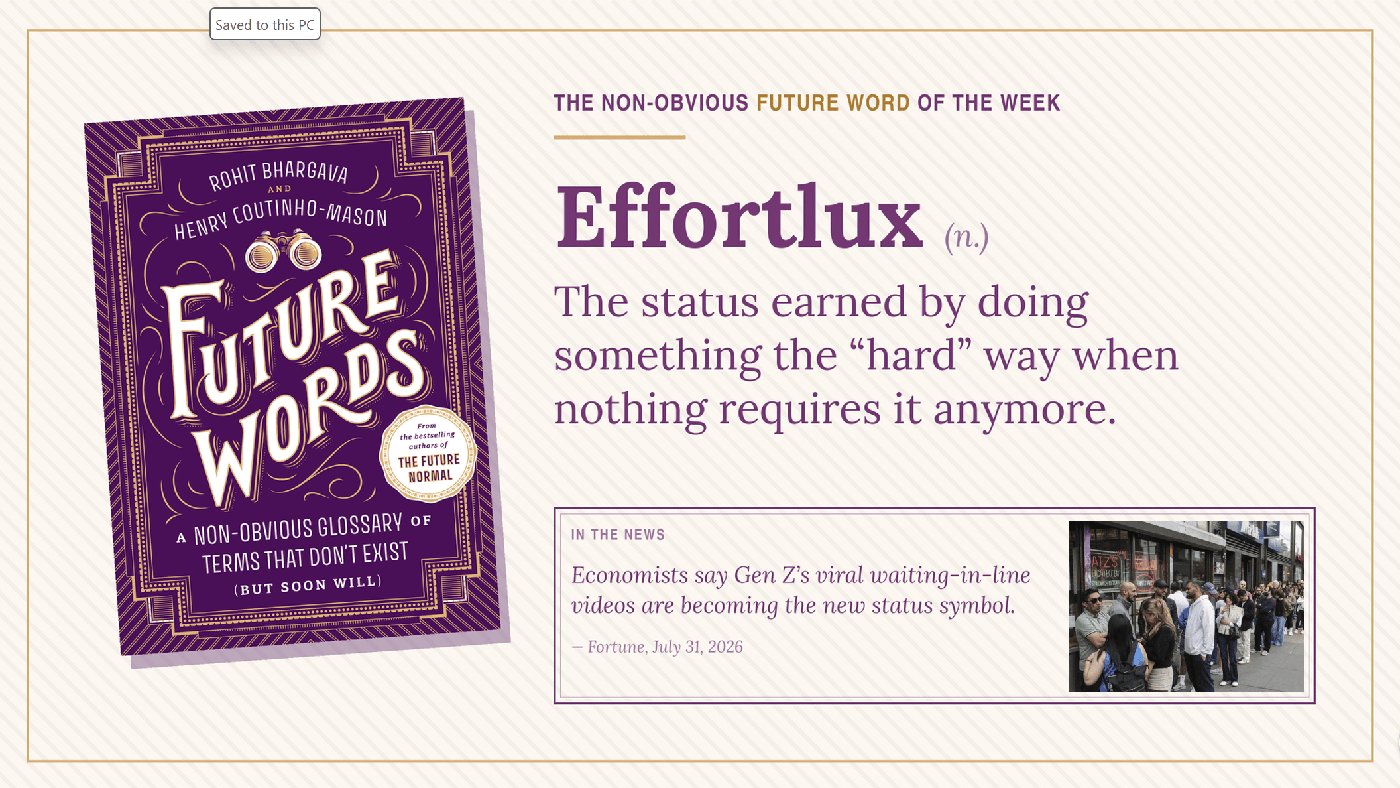
An article in Fortune magazine this week points to the rise in "conspicuous waiting" as the new status symbol as people proudly share images of themselves in line queued up for some sort of experience that is presumably worth the wait. The term comes from the work of economist Thorstein Veblen who we also referenced in Future Words as part of our coinage notes for the term Effortlux:
Effort + luxe. More than a century ago, Thorstein Veblen argued that the wealthy display status through “conspicuous abstention from labour” in The Theory of the Leisure Class (1899). The embrace of non-work used to be the luxury, but now that labor is increasingly automated, the struggle and effort become a status-making, symbolic choice.
Our word was inspired by seeing more examples people choosing to do things the "hard way" like making their own sourdough bread or choosing to add more friction and authenticity back into their travel. Now it seems that the wait itself can also be a signal of this same willingness to spend "unnecessary" time on something as a way to indicate a devotion and embrace of the experience itself.
The Non-Obvious Media Recommendation of the Week: Boing Boing
Boing Boing may be as close to an "OG" Internet news website as you're likely to find. First started in 1995 (a full year before Craig Newmark turned his personal email database into Craigslist) as a collection of "wonderful things," the site has continued for decades to surface interesting perspectives and been a mainstay for millions of people online including myself. The design remains retro, the perspective is short and punchy - and for a site that has been around for so long, it's fascinating just how on trend and relevant the content still manages to be.
Boing Boing publishes a mix of original reporting, link curation, and personal commentary. We cover technology, culture, science fiction, makers, civil liberties, art, design, weird internet phenomena, and whatever else we find interesting. Most posts are short — a link, an image, a thought — and reflect the voice and opinions of their author. Some are longer features. Many are playful. Some are angry. Few are neutral. We have a perspective, and we don't hide it. Boing Boing supports civil liberties, privacy, free expression, open culture, makers and DIY, and is skeptical of concentrated corporate and state power. These commitments have held across decades and across whichever party happens to be in office.