What’s In This Issue?
 Story 01Why To Stop Underestimating the Ig Nobel Awards
 Story 02Yes, Social Media Has Gotten Quantifiably Shittier
 Story 03What Is The Point of An Awards Show?
 Story 04Should We All Choose Media Based On the Rage It Causes?
 Story 05Shamehire
 Story 06Don't Smash The Watermelon
Even More Stories
- UN votes to support map projection that accurately shows the size of Africa after centuries of distortion
- When plastic companies write the lesson plans for school curriculum
- Beyond coal: China’s installed solar power capacity crosses historic threshold
- Former ‘60 Minutes’ Managing Editor Says Fired Staffers ‘Refused to Be Accomplices’ in CBS Show’s ‘Destruction’
Media Recommendation
 VentureBeat
Why To Stop Underestimating the Ig Nobel Awards
It's easy to poke fun at scientists studying the effects of burying underwear. Or the team exploring the nutrition density of cockroach milk. The Ig Nobel awards are known as the "silliest awards in science" where researchers are chosen for ridicule based on their obscure or seemingly ill-advised research quests. Taunting venomous snakes to study why they bite or asking why bedsheets get wrinkled isn't for everyone. Though these sorts of questions may not seem useful, there is an underlying truth about what these awards expose year after year that I find intriguing.
There are people who ask questions that others don't. Some, like Dr. William B. Bean (yes, real name), famously tracked the growth rate of his own fingernails for 35 years. His conclusion? Human nail growth rates slow down over time and middle fingernails grow faster than the others. Will this knowledge change your life? Perhaps not, but there may be an unexpected upside:
While, on the surface, the Ig Nobels might seem like a silly, good time, there is a point to the zaniness: the awards’ twofold purpose is to make people laugh and then think. Scientific advancements don’t proceed in linear fashion; they usually zig and zag before reaching any point of significance for everyday people’s lives. Take, for instance, research honored in 2012 in which scientists used a functional magnetic resonance imaging (fMRI) machine to find dubious signs of “brain activity” in a stone-dead Atlantic salmon. That seemingly laughable result ultimately led neuroscientists to rethink how they analyze their data.
Along with the fun and quirkiness, the awards also show that listening to people who are bold enough to ask and study the questions that others never think to ask might also offer an underappreciated roadmap to innovation too.
Yes, Social Media Has Gotten Quantifiably Shittier
Social media enshittification has become a popular idea. The term, coined by writer Cory Doctorow, describes the idea that there was a time early in the evolution of many social media platforms like Facebook or Twitter when the user base found them universally delightful and useful. People authentically connected with one another, voices felt democratized and advertising (largely) was missing. The tools were about the people. But over time, Doctorow argues, each of these platforms became compromised by the pressure to scale, monetize and turned into forces of manipulation and addiction.
In a new article NYU Professor Ruby Thelot argues that enshittification isn't real, it's "merely platform narcissism." His argument is that the real problem is:
"What people call enshittification is the feeling of feature-need dislocation. In this case, it is felt by mostly geriatric millennials. The platforms are more popular than ever. You can see it in the Monthly Active Users (MAU) growth mentioned above, 140% in ten years. The revealed preference is that people are using them more and more. Moreover, satisfaction surveys such as ACSI indicate that satisfaction with social media has remained consistent in the last 8 years, with a slight increase in the last three years, from 2020 to 2025, satisfaction grew from 70 to 75 (out of 100). Contrary to the enshittification narrative, when broken down by platform, all platforms show increases in satisfaction."
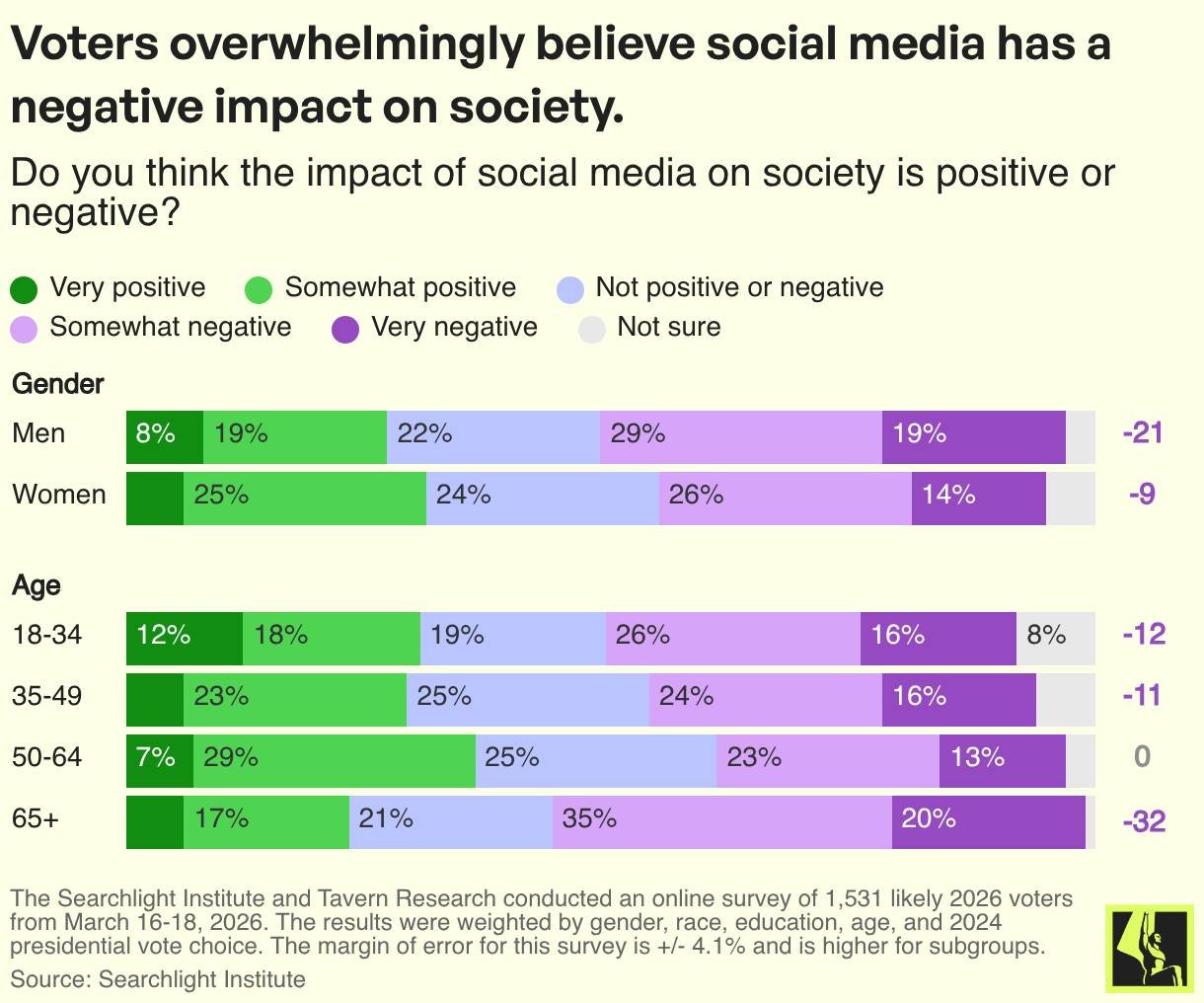
The problem is, as 404 Media astutely points out, "Thelot’s argument falls apart when he tries to prove people are actually satisfied with their time on these platforms." There is plenty of data to show that young people are largely unhappy with the amount of time they are spending on social media and dislike what it has done to their relationships and its negative impact on human society. As someone who fits that "geriatric millennial" age range, I do think social media has indeed enshittified itself ... and in almost every measurable way, from the quality of posts to the invasiveness of advertising, the "good old days" of social media were infinitely better. Do you agree?
What Is The Point of An Awards Show?
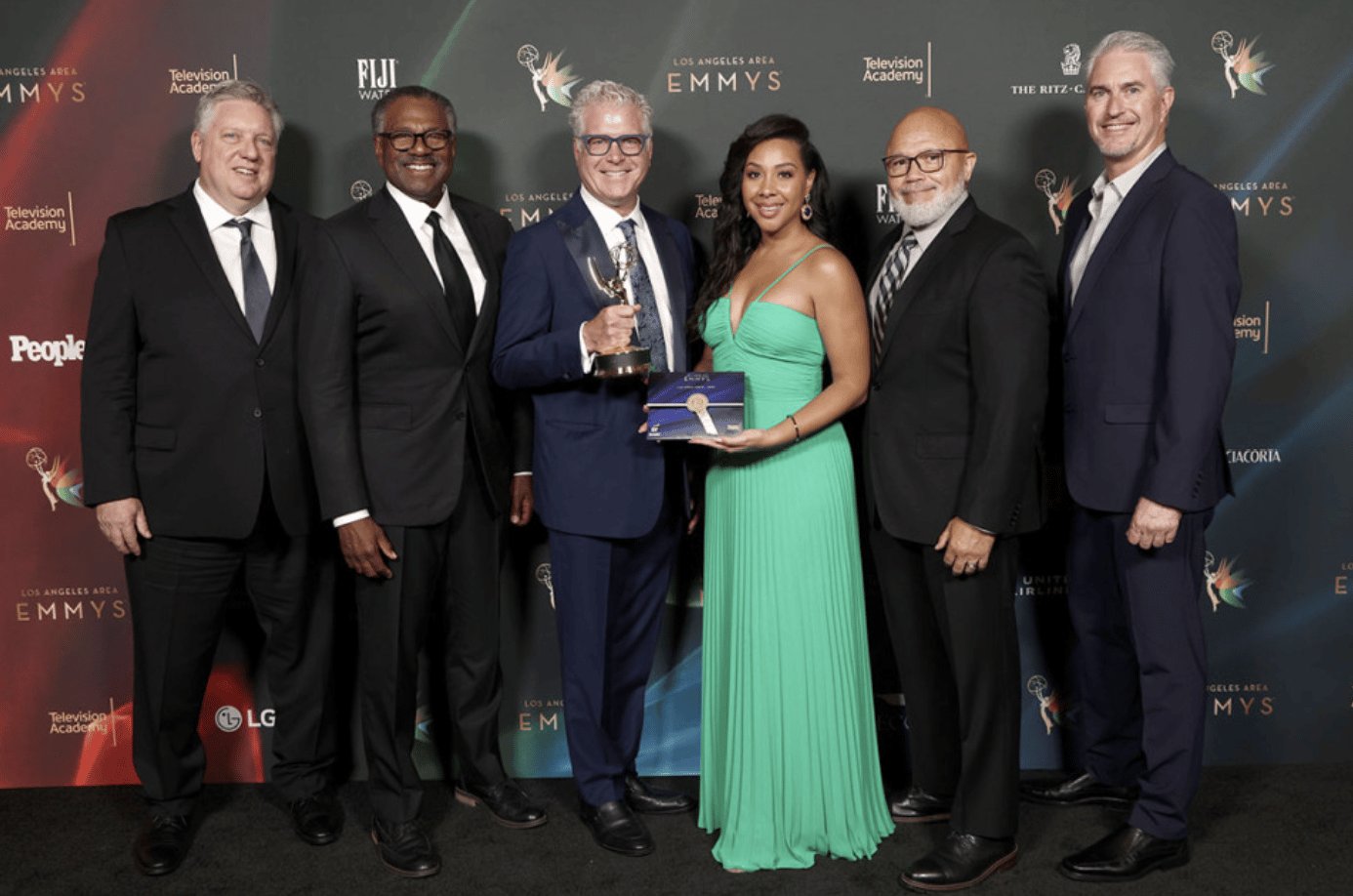
This week the organizers of the Emmy Awards decided to reduce the number of awards presented live on the show from twenty-six last year to nineteen this year. The rationale is that this will free up the show to offer more live entertainment and make it more fun to watch for the television-loving general public.
The move has already been condemned by several industry trade groups including the DGA, SAG-AFTRA and the WGA who all issued a joint statement saying that "the decision to eliminate these categories from the prime-time broadcast devalues the contributions of the talented people the Academy is meant to honor. An awards show dedicated to recognizing excellence should not reduce recognition for the artists whose work gives it meaning.”
The question this raises, though, is who is an awards show really for? I've been invited as a speaker to more than dozen events where awards were also presented. Usually it is to recognize people in front of others from their professional or personal community. The Emmys, Tonys, Grammys and Oscars are all different.
They have an audience of industry peers in the room, but they also have a live audience who don't really care who won the award for Best Cinematography and would rather experience moments such as the red carpet arrivals of stars or the rapport between presenting duos. So maybe the best solution is to have two award shows. The first for the industry and another where the entertainment value of the show is prioritized. What do you think? And will you be watching the Emmys this weekend?
Should We All Choose Media Based On the Rage It Causes?
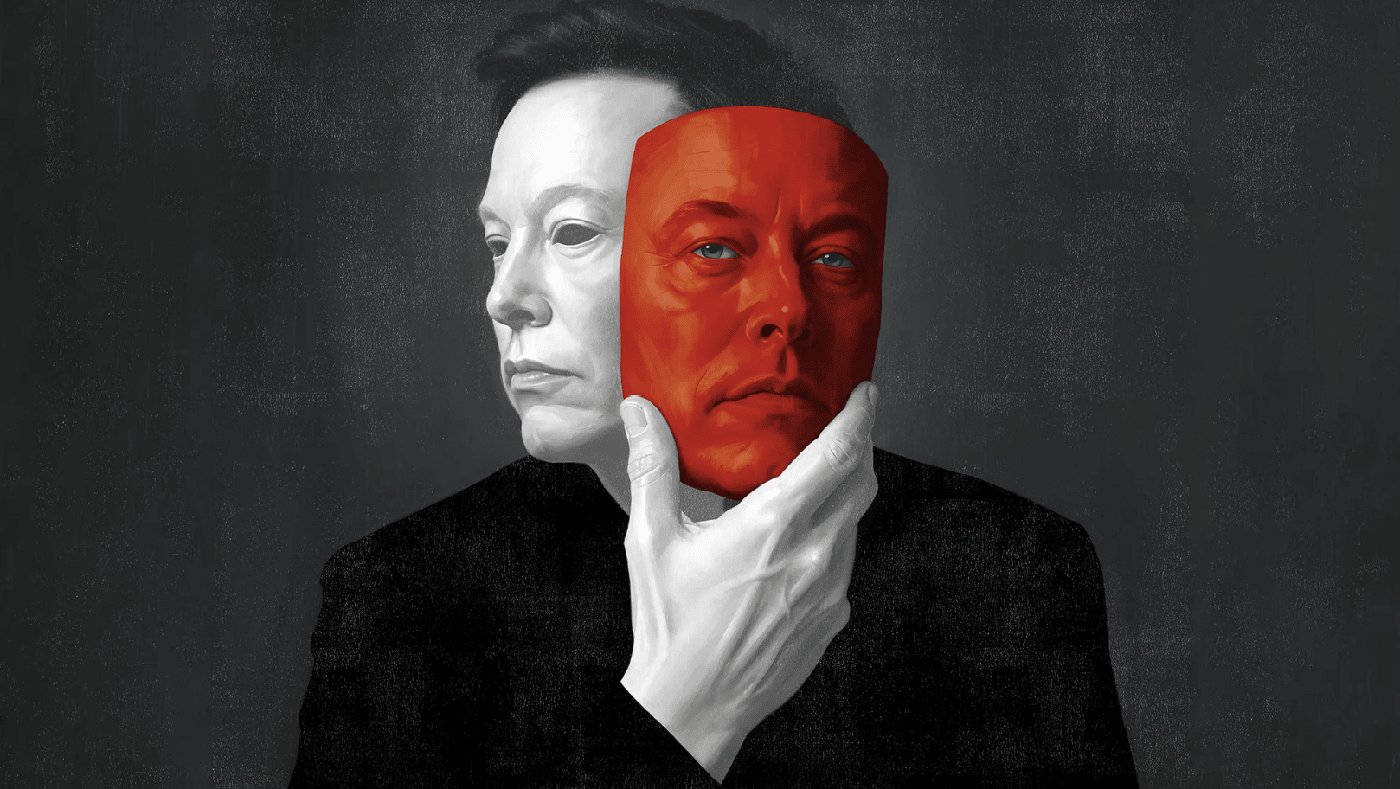
There is a new four-hour documentary about Elon Musk and he is raging about how it's a "hit job." The upcoming movie about Sam Altman's sociopathy is also getting similar PR responses from the Open AI team. Last year, Meta had a similar response to the explosive book Careless People about the leadership failures of Mark Zuckerberg. The year before that, President Trump raged about The Apprentice - a film about his business failures from early in his career. This is sort of the opposite of ragebaiting. Media that incites rage and angst in one person or a small group of people who are the subject of truthtellers who expose them for who they are.
It's something I was thinking about this week as I started watching another show called The Audacity. It's a dark satire of Silicon Valley with plenty of villains that are pretty clearly modeled after real companies and people. The behemoth tech brand is called Cupertino, and their CEO is "big Tim." The show is described as being "powered by a sustaining belief: that the business it chronicles is no longer about creation but about extraction. Its version of Silicon Valley wants to strip-mine its consumers’ digital lives for granules of precious ore." It's hopeless depiction of Silicon Valley also created a stir ... and also seems highly plausible.
All of these examples led me to the central question of this article. The TV shows, movies or books that irk their subjects this deeply probably do so because they come closest to the truth. Should that make them irresistible (and necessary) for all of us to seek out and consume?
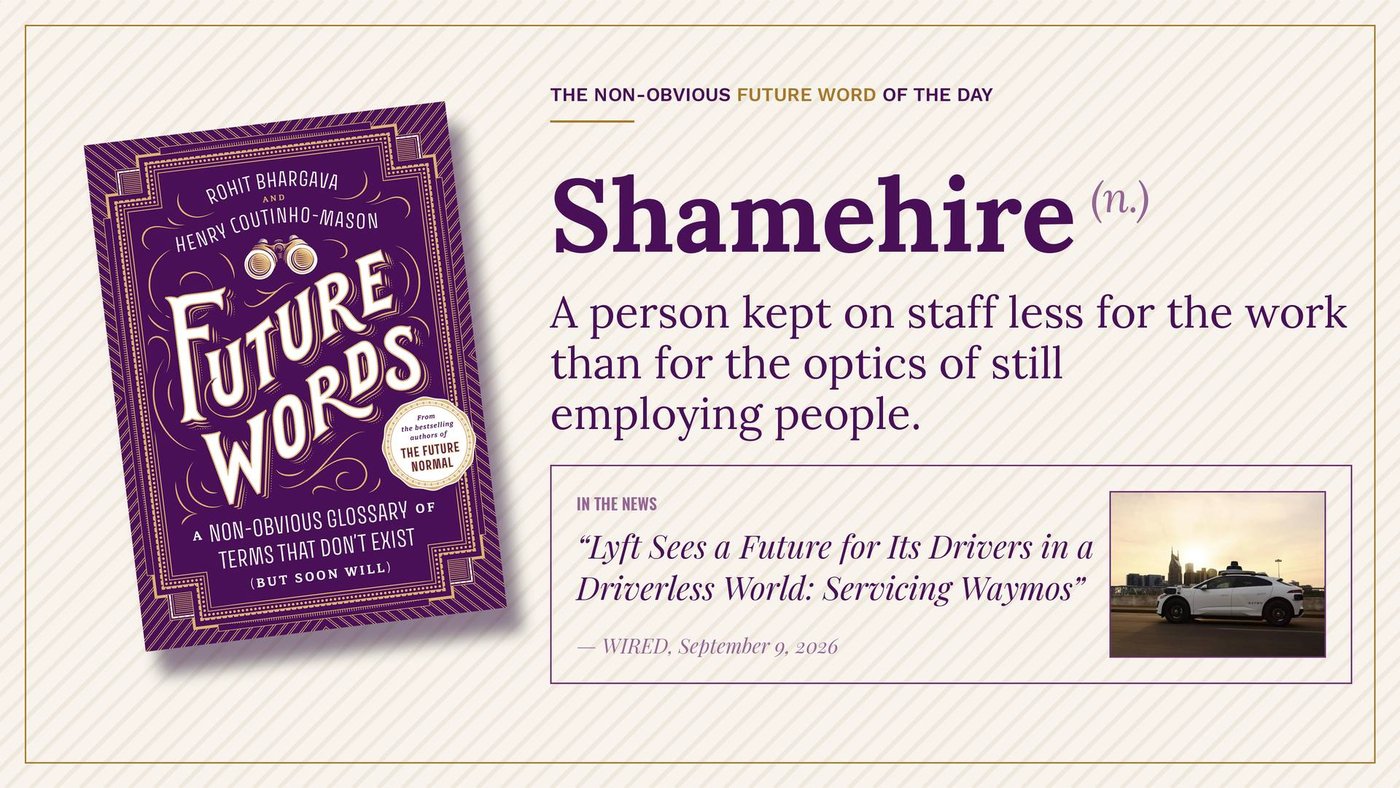
Shamehire
There's a moment from the hit show The Office where a self-created ad for the Dunder Mifflin paper company offers this ironic tagline: Limitless paper for a paperless world.
The joke is about their own impending obsolescence and it's simultaneously funny and heartbreaking. Laughing at the demise of one's own industry. This isn't exactly the same thing, but when Henry and I were researching words and landed on shamehire - we imagined it might awaken a similar emotional response. How should we feel about a world where people are only hired for the optics of continuing to employ humans while automation does the "real work"?
This week there was a story from WIRED about Lyft's latest shifts to hire humans to clean and service self-driving cars. The people are no longer the drivers. They are the supporting staff and in the future this will no longer be a rarity. So what happens to anyone's self worth and feeling of purpose from their job, if and when they know that a large part of the motivation to hire them in the first place was the positive PR that comes from still hiring humans?
Don't Smash The Watermelon
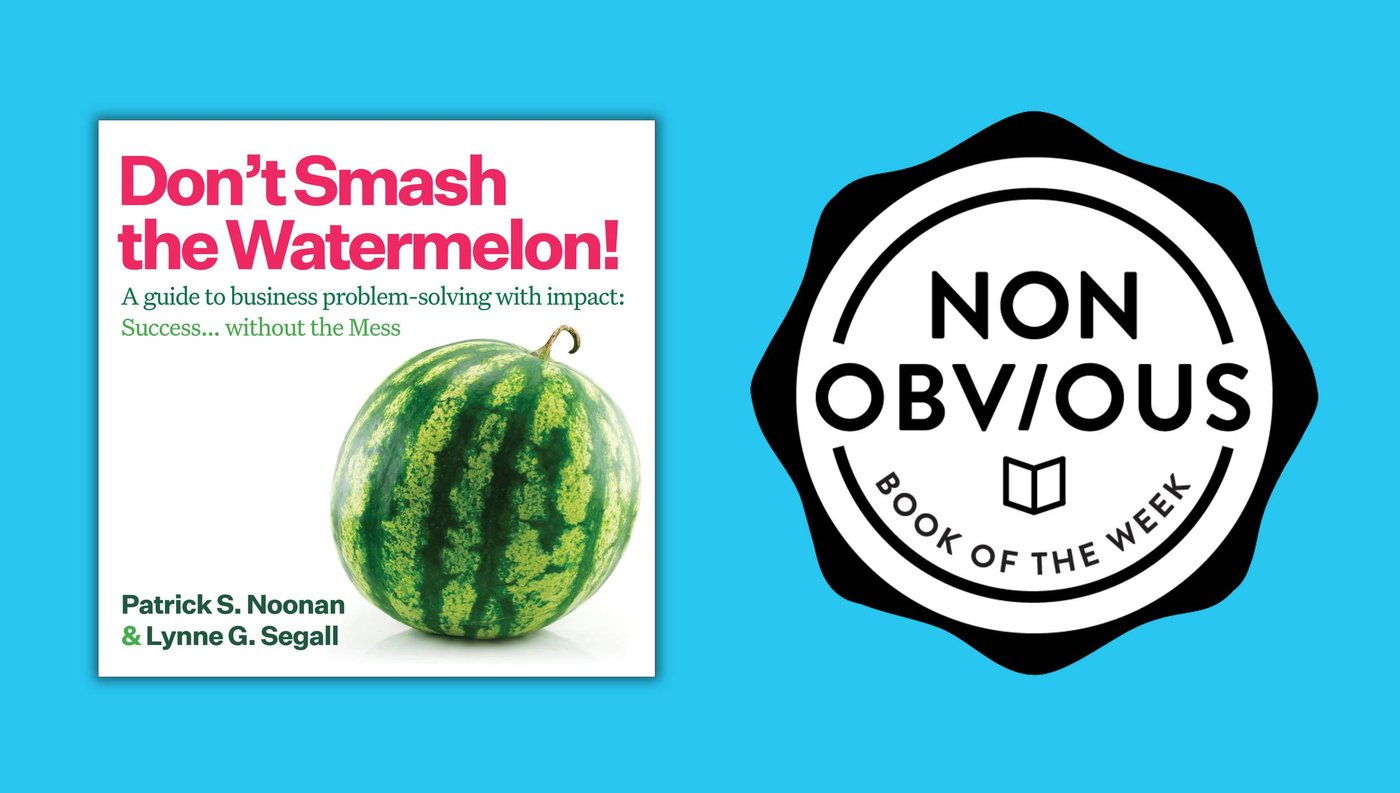
There is a business problem solving method that is widely used and deeply flawed. When we face problems, we often break them down into components and then set teams and individuals off to solve those components. As authors Patrick S. Noonan and Lynne G. Segall argue, this is the metaphorical equivalent of smashing the watermelon and it doesn't work. Instead, their highly visual new book offers a different method for problem solving. It's one that hundreds of MBA candidates and business students at the Goizueta School at Emory University (my alma mater!) are already using. The book is beautifully illustrated and uses those detailed graphics to outline new methods for problem solving that are applicable for any size business. If you are looking for some tested methods on solving problems of all sizes, this one should be your next read.
*Note - This is an Ideapress book and I advised the authors during the development of this book.
The Non-Obvious Media Recommendation of the Week: VentureBeat
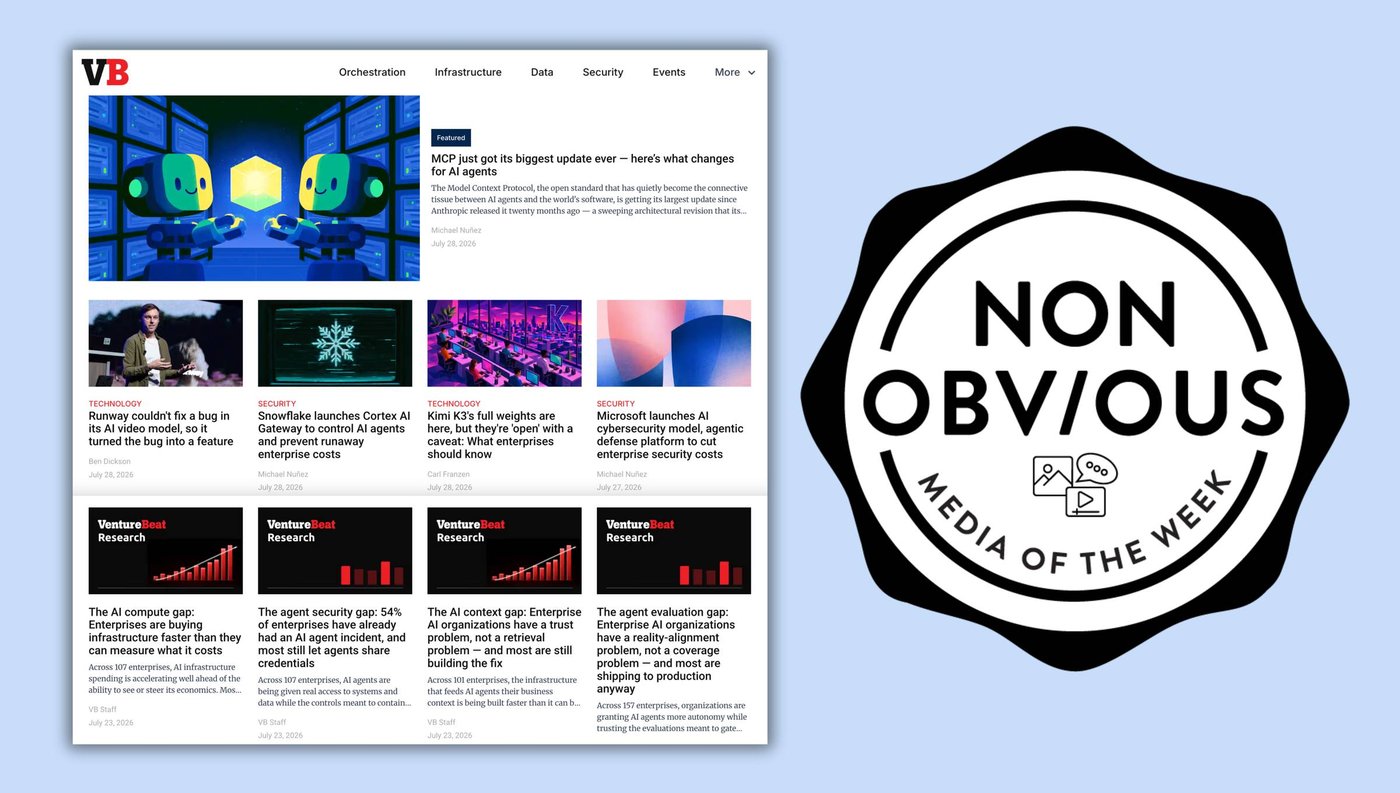
For more than you ever wanted to know about emergent AI technology and companies, VentureBeat is the ideal source. The site is positioned as the "independent voice on AI" and is a daily (if not hourly) read amongst many of the people who work in the SF tech scene or aspire to make big waves (and money) with their own AI startup. As a result, the stories from VB offer plenty of AI hype, a regular case of misplaced optimism and a sometimes concerning lack of context about the downstream implications of new technology, but it's also an authoritative source on the fastest moving of industries and an essential site to add to your media list if you're eager to get the latest AI news as it breaks.