What’s In This Issue?
 Story 01Can Brand America Be Destroyed?
 Story 02Astronauts Are Leading The Quest To Prevent Space Advertising From Filling the Sky
 Story 03The Quest to Prevent Scalpers and the Rise of the Freebie Bots
 Story 04Adobe Acrobat AI Assistant Is Exactly What Anyone In Business Really Needs
 Story 05Look Again by Tali Sharot & Cass R. Sunstein
Media Recommendation
 Tech Safari
Can Brand America Be Destroyed?
Diplomats and trading partners don’t trust the word of America anymore. Countries are hosting summits and meetings to discuss alliances specifically omitting the US. Politicians in other countries are winning elections because they argue against America. There are even kits for sale online to help Americans who do travel abroad to disguise themselves as more universally appreciated Canadians. As an article from Fast Company this week suggests, perhaps Brand America itself has become toxic.
And if that’s true, the impact will not just be felt through tariffs or shifts in global trading. America’s most powerful export has always been its culture—shared through media, film, television, music and sports. Can this juggernaut start to lose its influence too? And if so, what might take its place? To me, the real question is the long term one. Are the actions of America’s current President irreversibly harming the country or could all that be reversed when the country’s leadership eventually changes? In the short term, this is going to continue to create disruption and opportunity too. Expect to see experiences that promote anti-American perspectives and products that could be presented as “America-free” in some way. In this sense, brand America has indeed become something no company really wants to promote right now.
Astronauts Are Leading The Quest To Prevent Space Advertising From Filling the Sky
The Committee on the Peaceful Uses of Outer Space (COPUOS), is a beautifully imagined group within the United Nations that aims to make sure space doesn’t get misused as the costs for launching satellites continues to go down and the industry continues to privatize. Investor plans show there are several companies aiming to put hundreds of laser-fitted small satellites into orbit roughly 370 miles above Earth’s surface by 2030. Altogether, this many satellites could work together like a space billboard.
According to the astronauts (and many others), there are some real scientific drawbacks to allowing this sort of “entertainment” to happen from the skies such as the disruption of ongoing astronomy efforts. Not to mention hampering our ability to detect dangerous meteors. The most dystopian problem, though, is clearly the fact that this sort of billboard would be impossible for anyone to avoid. Being able to use the skies as a canvas is a bad idea solely for the fact that if it were possible, the exact wrong people would have the money and motivation to use it. For example, one of those company’s founders has already said that he wants “to prove that space is not just for scientists, not just for the military—it is entertainment, too. And people like entertainment.” Well, people like good entertainment. And it’s pretty obvious that isn’t what we would get.
The Quest to Prevent Scalpers and the Rise of the Freebie Bots
There is a word for people who buy a child’s game when it first comes out and then immediately try to sell it online for a huge profit: assholes.
Ok, technically the more common and polite term would be scalpers. It’s a common problem, though. Particularly when it comes to the still popular game of Pokémon where new card packs can be bought and sold online with ease. Recently, to try and curb this black market game, Pokémon Center Singapore has confirmed they will be removing the plastic wrapping from the cards at the point of sale in all cases, effectively devaluing the product in case someone was trying to sell it later.
While this may work in this one case, it’s just one part of a more interesting retail shift here being driven by AI and so-called “freebie bots” which are different from the bots used for scalping because they are not using AI to get in line first to buy a product or ticket and then flip it for an exorbitant profit. Instead, these freebie bots scour the web for pricing mistakes or big discounts which online resellers use to get products for very low rates and then they mark them up to near retail prices and pocket the profits.
Of course, there are tools to help retailers find and prevent such bots too. This is the retail AI game and it’s being waged beneath our clicks by bots seeking out deals and trying to buy goods, and technology purposely built to foil their efforts. As we read more about an agentic AI future in retail, there is a lot of attention on how it will shift product discovery and the relative importance of brand. Potentially even more important is how it could shift the financial side of purchasing, driving people to buy things they don’t need simply because they are alerted and see that something is on a huge discount.
When this becomes more commonplace, scalpers will likely move a lot lower on the list of retailers’ biggest concerns.
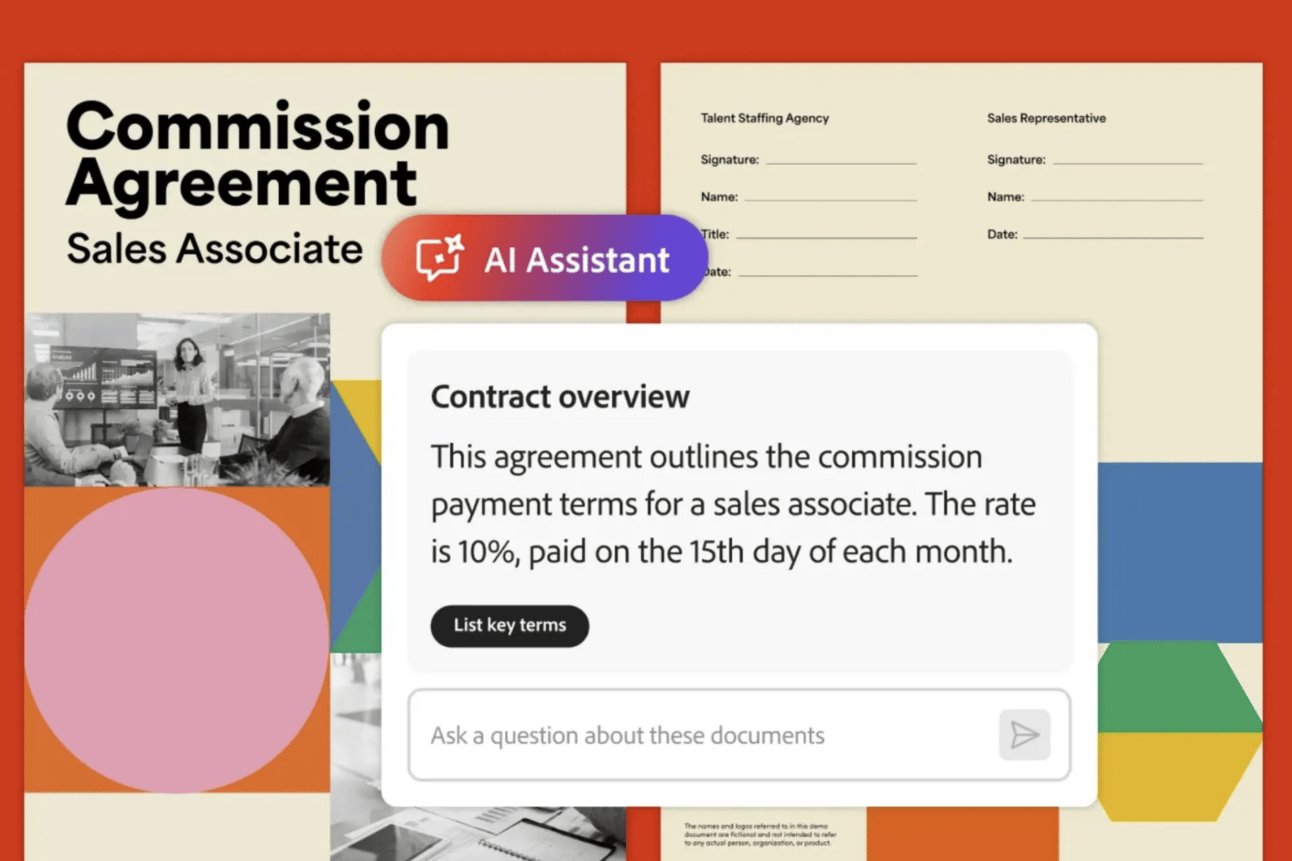
Adobe Acrobat AI Assistant Is Exactly What Anyone In Business Really Needs
This past month Adobe launched a super useful enhancement that I’ve been testing it for a bit. The Adobe AI Assistant has a number of features to help anyone more easily understand what contracts are actually saying. Given most contracts are in PDF format, it’s a perfect extension to have this built into Adobe. The tool allows you to easily extract a list of deliverables, find key dates and more easily see changes from one version of a contract to another. If you use your own contracts, it can also help you improve them by assisting in the development of a “plain language” version of your agreement to aide understanding.
This is something that we have done for years already, but using Adobe’s tool helped us to find elements of our contracts that may not have been quite as clear and integrate those descriptions into our plain language version too. Which demonstrates another potential upside of this new feature … the transparency it can create could help all of us to produce better and clearer contracts ourselves instead of relying on the same agreements originally written by lawyers years ago and therefore probably more confusing than they need to be.
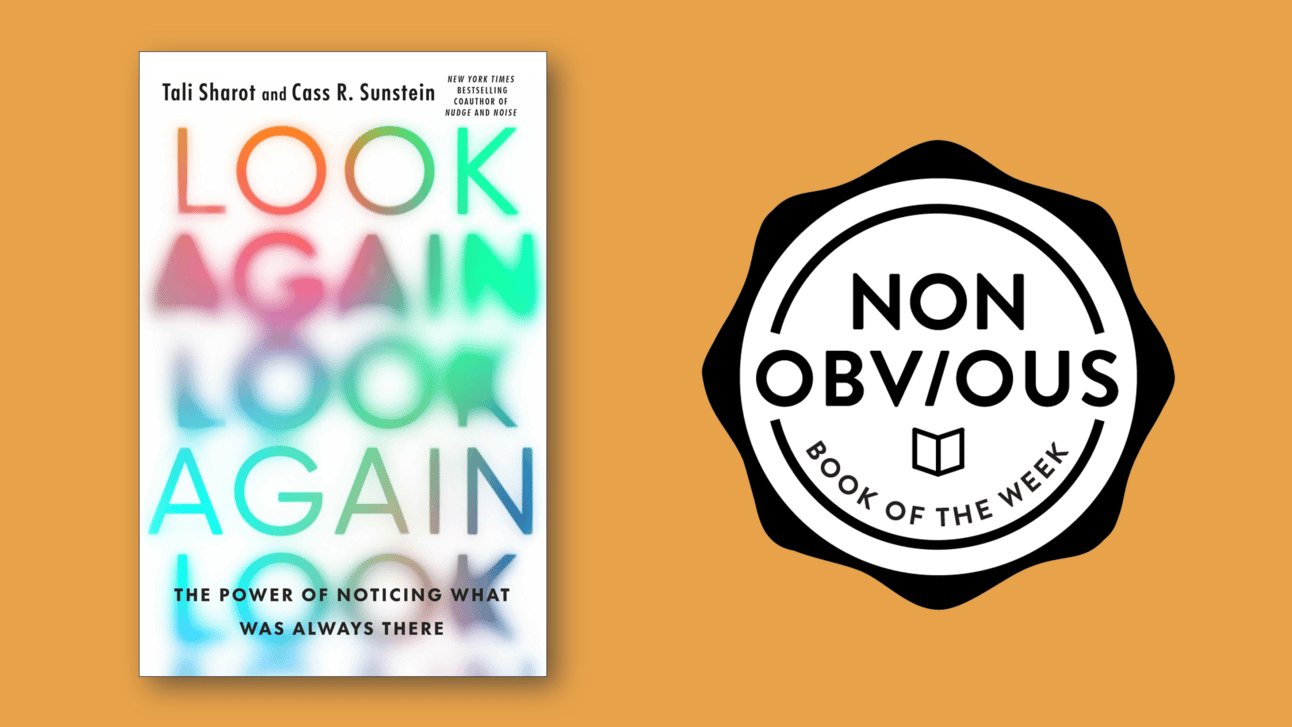
Look Again by Tali Sharot & Cass R. Sunstein
Humans are great at habituation. We can get used to when things are great and we can get used to when they aren’t too. Both situations can be a problem. The secret to really being more fulfilled may lie in our ability to dishabituate. That’s the simple premise Look Again, a book that delves into the social science and research behind why challenging yourself to do this more frequently matters. It’s a message that resonated immediately for me, as did one of the opening stories where the authors share a relatable story of two women with nearly identical lives. Happy marriage, healthy children, nice home. All the external factors. The difference? One woman travels often for work, returning home and appreciating all that she has because she has frequent times away from it. The other, who doesn’t have the same travel schedule, struggles to find the same appreciation.
Of course, it doesn’t happen this way for everyone—but the travel itself is a force which helps create dishabituation and this quality makes it useful to remind anyone to appreciate what they do have. We hear advice like this often: appreciate what you have. Be grateful. In Look Again, the authors offer a practical way to really put this into action by honing your ability to notice what is already there … but easy to miss.
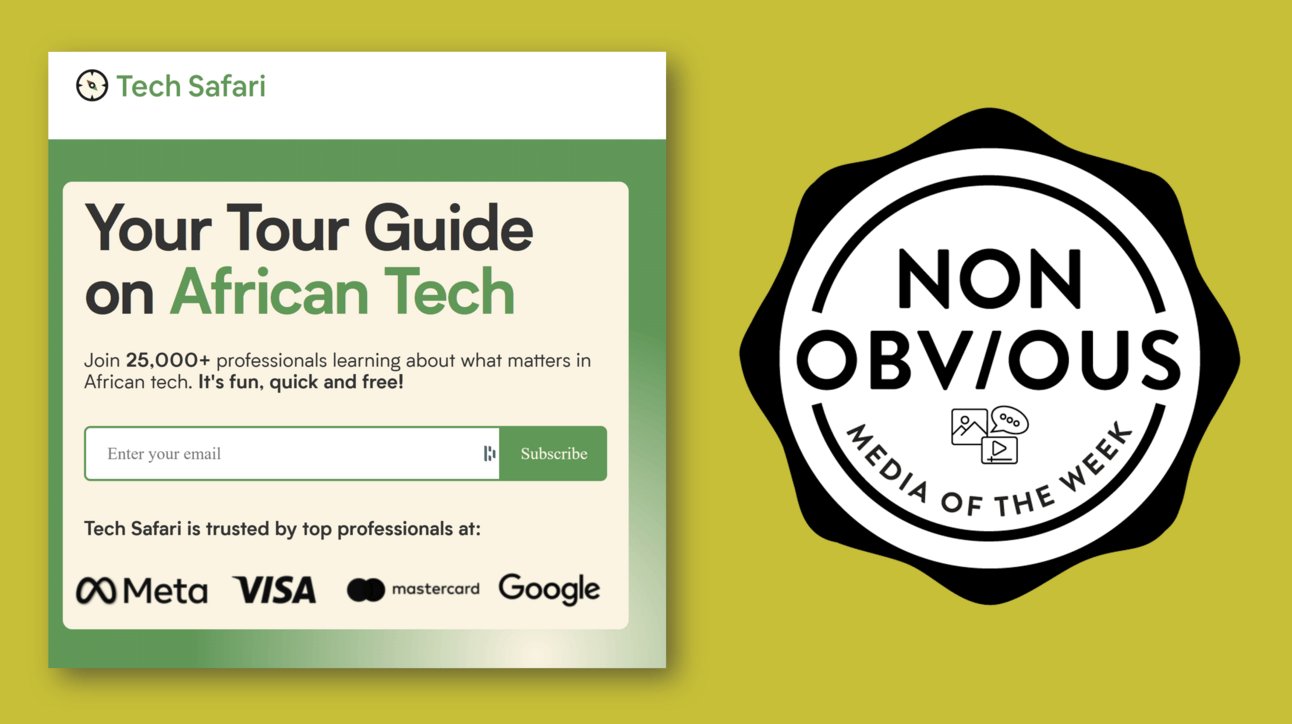
The Non-Obvious Media Recommendation of the Week: Tech Safari
How much attention do you pay to the latest innovations in African tech? The latest startups and tech founder news from the African continent are routinely ignored by most Western tech media sources. To remedy the gap, Tech Safari is one of the leading platforms dedicated to making sure Africa’s tech industry is not forgotten. From the latest wins of Botswana’s emerging space industry to the expansion of drone deliveries across Nigeria, Tech Safari’s newsletter is a great source to open your perspective to the fact that tech innovations are happening everywhere in the world. And sometimes the most futuristic initiatives start in places where the older ways of thinking don’t present as many logistical or infrastructure-based barriers to doing new things.